Short answer
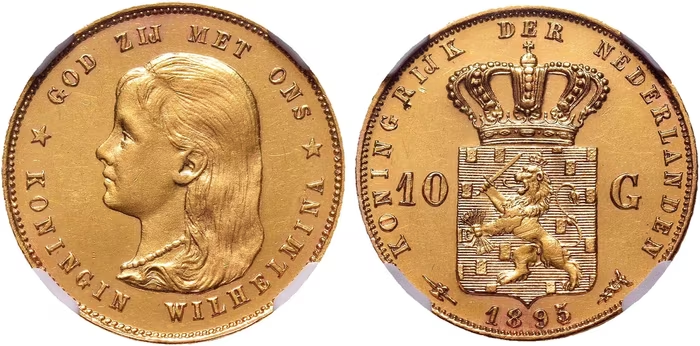
A gold 10 gulden is worth at least the melt value of approximately 6.048 grams of fine gold. In practice, the price offered by dealers is often lower than the current gold price. Rare dates and high-quality examples, however, can achieve auction prices reaching tens of thousands of euros.
Current gold price and indicative melt value
The current gold price shown below provides an indication of the melt value. This is not a fixed selling price and may differ from dealer offers and auction results.
The block above calculates the gold value. Whether your coin also carries collector value depends on its date and its condition. If you want to know for certain, have your gold 10 gulden appraised free of charge.
The gold value is the floor, not the ceiling
The most expensive 10 gulden in our auctions was an 1828 of William I at €110,000. Date, mint mark and condition make that difference. Send a photo of the obverse and the reverse and our numismatists will place your example within that range.
Request a free appraisalWhat is meant by a gold 10 gulden?
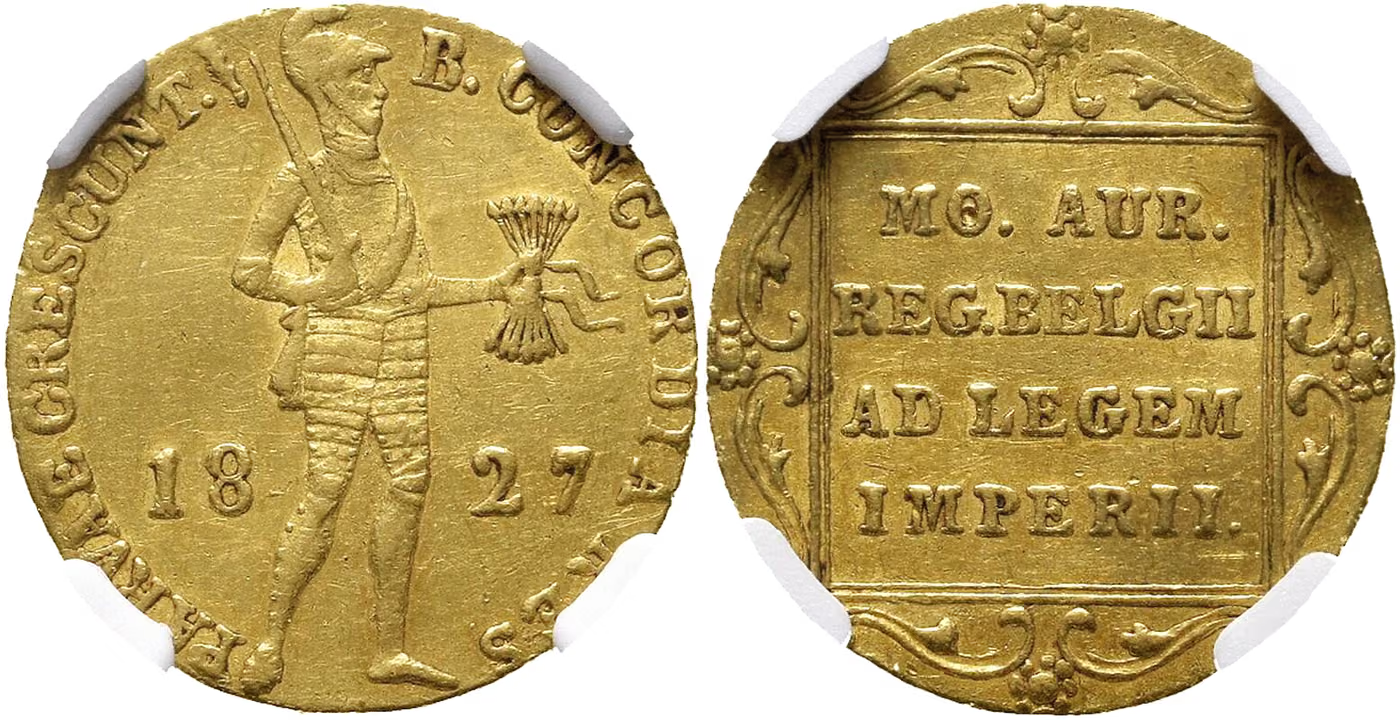
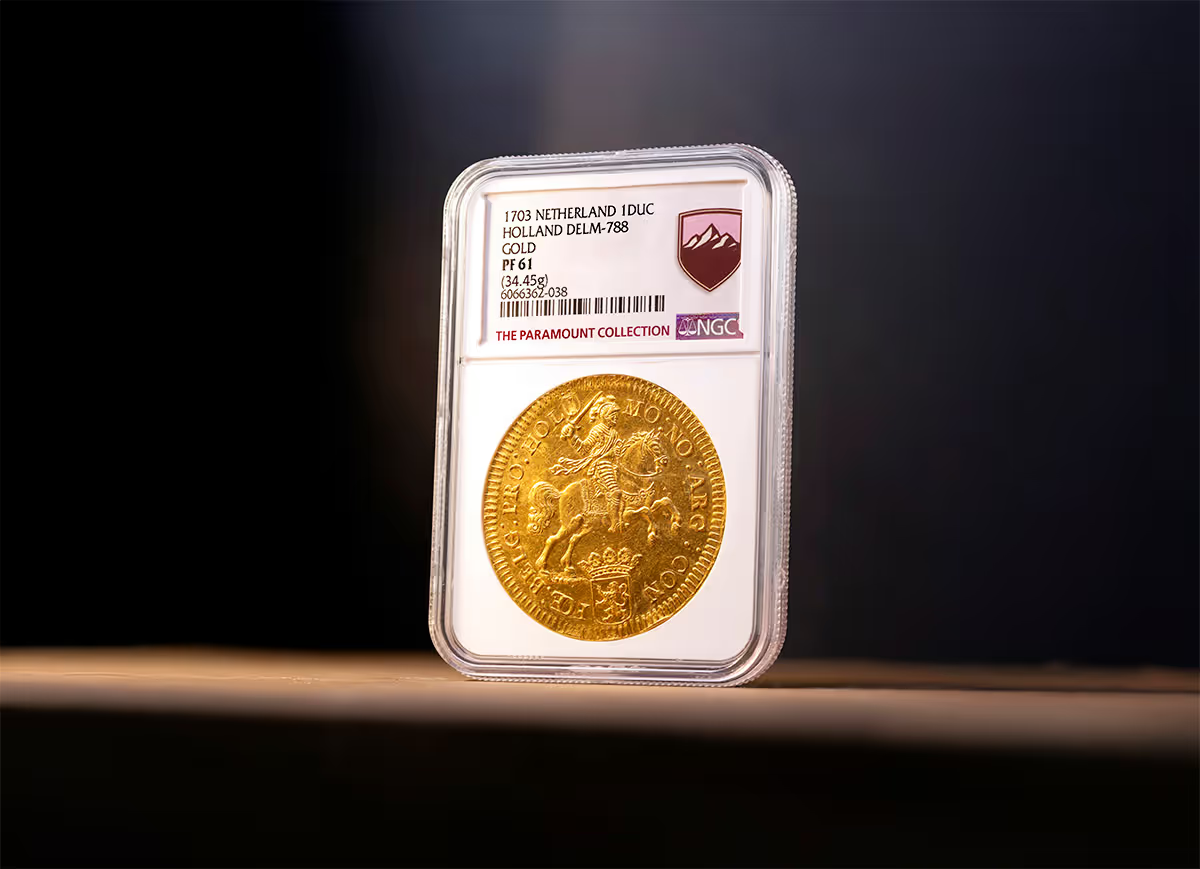
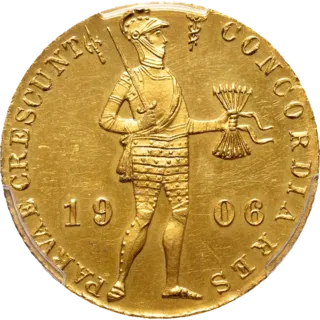
The term “gold 10 gulden” refers to Dutch 10-gulden gold coins struck during the nineteenth and early twentieth centuries. These coins were issued with fixed technical specifications and form an important part of Dutch numismatic history. Another well-known Dutch gold trade coin is the gold ducat.
In practice, most gold 10 gulden coins date from the reign of King Willem I and later periods. Not every gold 10 gulden is rare. Many dates are relatively common and are mainly traded based on their gold content.
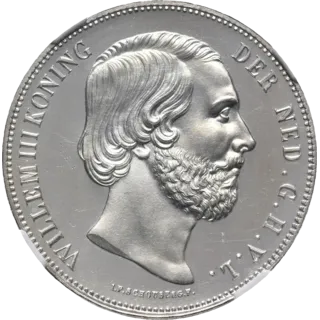
Do not confuse the gold 10 gulden with the silver denominations of the same era. A silver guilder or a silver rijksdaalder of 2½ gulden is valued in a different way: silver is worth far less per gram than gold, so rarity and condition carry more weight there than the metal itself.
Also see the value of

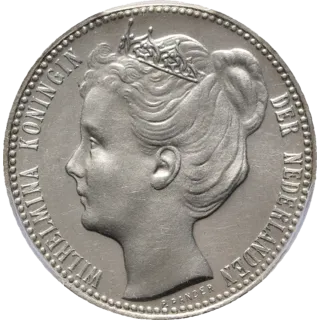
How is the value of a gold 10 gulden determined?
The value of a gold 10 gulden can be divided into three closely related levels:
- Melt value
- Dealer price
- Auction value
Melt value: the gold component
A gold 10 gulden weighs 6.72 grams and is struck in 900/1000 fine gold, corresponding to approximately 6.048 grams of pure gold.
The melt value is calculated by multiplying this fine gold content by the current gold price per gram. This represents a theoretical minimum value, not a guaranteed selling price.
The current gold price is not the same as the dealer price
A common misconception is that a gold 10 gulden always sells exactly at the gold price. In reality, this is rarely the case.
The price offered by dealers may be lower than the current gold price due to:
- buying and processing margins
- differences between paper gold prices and physical trading
- market liquidity and risk
- the fact that common gold 10 gulden coins are often bought as bulk gold
As a result, the dealer price can differ from the calculated melt value, even when the coin is undamaged.
When does collector or auction value arise?
A gold 10 gulden acquires genuine numismatic value when it is valued for more than its gold content alone. This applies in cases of:
- exceptionally rare dates
- specific types or varieties, such as clear overstrikes
- high quality, with sharp detail and original surfaces (see coin grading)
- a well-defined position within a specialised collecting field
In such cases, the gold price plays only a secondary role.
What is a gold 10 gulden worth today?
The day value of a gold 10 gulden is the value of the gold it contains, and it moves with the gold price every day. Because the coin holds 6.048 grams of fine gold, you calculate the day value by multiplying that weight by the current gold price per gram. The gold price block at the top of this page gives that indication.
What the coin actually yields depends on the route you choose:
- Direct sale: you receive a price derived from the day value. As described above, trade prices generally sit below the spot price. Read more about selling gold coins.
- Sale by auction: for a common year this rarely adds much above the gold value. For a rare year or exceptional quality the result can be a multiple of the day value. See our upcoming auctions.
- Holding on to it: the gold component follows the gold price, while collector value follows demand among collectors. The two do not move in step.
The day value is therefore the floor rather than the ceiling. Which route yields most for your coin depends on its year and its condition. An appraisal shows which of the three makes most sense in your case.
Before or after 1875: a key difference in value
A useful rule of thumb for gold 10 gulden coins is the year 1875. From that year onwards, the Willem III type was struck in large mintages, followed by the very extensive Wilhelmina issues (running until 1933). These coins are widely available in average grade and almost always trade close to the current gold price, minus the usual dealer margin.
Gold 10 gulden coins from before 1875, such as the issues under Willem I, Willem II and the earliest Willem III years, were struck in far smaller quantities. Several dates from this period are genuinely scarce and rarely surface in high grade. For such coins, the auction value can be a multiple of the melt value, provided the coin:
- shows a sharp strike with little wear;
- retains original lustre (or attractive toning);
- is free from scratches, mount marks, or signs of cleaning.
A Wilhelmina 10 gulden from 1912 in average condition tracks the gold price. An early Willem I 10 gulden in Extremely Fine condition, by contrast, is primarily a collector's piece, with a price set by the market rather than the gold spot.
Not sure which group your coin belongs to? Have the date and condition assessed before you sell it as gold.
Do you know your date and mint mark?
In the tables below that is the difference between common and rare. Send a photo of the obverse and the reverse and our numismatists will identify the date, mint mark and condition.
Have your coin assessedRare gold 10 gulden coins: rarity by ruler (1815–1933)
Which gold 10 gulden coins are genuinely rare and which are common? The overviews below show, per ruler, the dates, the known mintage and a general rarity rating. We deliberately list no prices: they move with the gold price and the market and quickly become outdated. What does offer guidance is the relative rarity: how scarce a date is compared to the others.
Some dates occur as an overdate: a combined date such as 1832/22 means that the date 1832 was struck over the older date 1822. Overdates are almost always clearly scarcer than the regular issue and are therefore listed as a separate row in the tables.
- Very rare – top piece, seldom offered
- Rare – hard to find
- Scarce – limited supply
- Fairly common – regularly available
- Common – current trade coin, readily available
Look up your date in the tables below. If it is marked rare or very rare, the gold value is almost certainly not the ceiling, and an appraisal is the first step.
Willem I (1815–1840)
| Date | Mintage | Rarity |
|---|---|---|
| 1818 (pattern) | pattern | Very rare |
| 1819 | 107,413 | Rare |
| 1820 | 33,187 | Very rare |
| 1822 | 47,560 | Rare |
| 1823 | 266,248 | Fairly common |
| 1824 | 336,333 | Fairly common |
| 1824 · Brussels | 3,639,006 | Common |
| 1825 | 228,365 | Fairly common |
| 1825 · Brussels | 3,821,019 | Common |
| 1826 · Brussels | 78,562 | Rare |
| 1827 · Brussels | 133,736 | Scarce |
| 1828 | 14,640 | Very rare |
| 1828 · Brussels | 561,897 | Fairly common |
| 1828/27 · Brussels (overdate) | — | Scarce |
| 1829 | 9,484 | Very rare |
| 1829 · Brussels | 83,943 | Rare |
| 1830 | 568,434 | Fairly common |
| 1830/20–28 (overdates) | — | Scarce |
| 1831 | 98,959 | Scarce |
| 1831/30 (overdate) | — | Scarce |
| 1832 | 1,372,334 | Fairly common |
| 1832/22–31 (overdates) | — | Scarce |
| 1833 | 721,362 | Fairly common |
| 1837 | 457,686 | Fairly common |
| 1839 (lily mintmark) | 326,404 | Fairly common |
| 1840 (lily mintmark) | 2,760,356 | Common |
| 1840/37 (overdate) | — | Scarce |
Dates without a further mention were struck in Utrecht; "Brussels" refers to the Brussels mint (mintmark B). The 1820, 1828 and 1829 from Utrecht are the great rarities of this series. The mintages of 1824 and 1825 · Brussels are documented figures; in addition about 30,000 pieces were struck whose date can no longer be determined. For overdates the mintage is included in the base year.
Willem II (1840–1849)
| Date | Mintage | Rarity |
|---|---|---|
| 1842 | 860 | Rare |
Under Willem II only the 1842 date was struck as a gold 10 gulden, with a very small mintage of 860 pieces. That makes it one of the key dates of the entire series.
Gouden Willem (trade coin worth 10 gulden)
| Date | Mintage | Rarity |
|---|---|---|
| 1848 | 101 | Very rare |
| 1850 | pattern | Very rare |
| 1851 | 10,000 | Rare |
The Gouden Willem is not an ordinary gold 10 gulden but a trade coin (negotiepenning) worth 10 gulden, carrying the sword mintmark. All three dates are rare: the 1848 (mintage 101) and the 1850 pattern strike are seldom offered.
Willem III (1849–1890)
| Date | Mintage | Rarity |
|---|---|---|
| 1875 | 4,110,000 | Common |
| 1875/74 (overdate) | — | Fairly common |
| 1876 | 1,581,106 | Common |
| 1877 | 1,108,149 | Common |
| 1879 | 581,036 | Common |
| 1879/77 (overdate) | — | Fairly common |
| 1880 | 50,100 | Common |
| 1885 | 67,095 | Common |
| 1886 | 51,141 | Common |
| 1887 | 40,754 | Common |
| 1888 (halberd mintmark) | 35,585 | Fairly common |
| 1889 (halberd mintmark) | 204,691 | Common |
From 1875 onwards the gold 10 gulden was struck in large mintages; these dates are common and largely follow the gold value. The 1875–1887 dates carry the axe mintmark, 1888–1889 the halberd mintmark. The earlier dates 1849–1874 were not struck as a gold 10 gulden.
Wilhelmina (1890–1948)
| Date | Mintage | Rarity |
|---|---|---|
| 1892 | 61 | Very rare |
| 1895/91 (overdate) | 149 | Very rare |
| 1897 | 453,696 | Common |
| 1898 | 99,239 | Fairly common |
| 1911 | 774,544 | Common |
| 1912 | 3,000,000 | Common |
| 1913 | 1,138,476 | Common |
| 1917 | 4,000,000 | Common |
| 1925 | 2,000,000 | Common |
| 1926 | 2,500,000 | Common |
| 1927 | 1,000,000 | Common |
| 1932 | 4,323,952 | Common |
| 1933 | 2,462,101 | Common |
The 1892 (mintage 61) and 1895/91 (mintage 149) dates are the absolute key dates of the gold 10 gulden and are seldom offered. The 1897 occurs with fixed and loose pearls (a minor variety). The 1897–1898 dates carry the halberd mintmark, 1911–1933 the seahorse mintmark. The other dates are common and largely follow the gold value.
Highest auction results for gold 10 gulden coins at Schulman
The following auction results illustrate how large the gap can be between melt value and auction value.
Did you find your date listed as scarce or rare in the tables above? Then it is worth having the coin assessed before you sell. Send in a photo for a free appraisal or read what selling gold coins at Schulman involves.

10 Gulden 1828 – Willem I
Auction result: €110,000
Auction: Selection Auction 375 (April 2023)
The gold 10 gulden dated 1828 is regarded as the rarest gold 10 gulden of the reign of Willem I. This Type I a issue (1818–1837), struck in Utrecht with torch and caduceus mintmarks, is exceptionally scarce in collecting practice.
Despite a seemingly moderate original mintage, this date has appeared only twice in Schulman sales since 1880 and is absent from the collections of J. Berkman, Rijnbende and Virgil M. Brand.

10 Gulden 1810 – Louis Napoleon
Auction result: €75,000
This gold 10 gulden was struck during the French period under Louis Napoleon, King of Holland. Its historical context, combined with limited availability and sustained international demand, makes it one of the most sought-after Dutch gold coins.
What do these results tell us about the value of a gold 10 gulden?
These examples demonstrate that:
- the gold price provides only a baseline
- the dealer price may differ from that baseline
- the auction price is determined by rarity, quality and demand
For that reason, the question “What is a gold 10 gulden worth?” can only be answered by looking at the specific coin.
We look at which route pays best: a direct sale or a place in the auction.
A gold 10 gulden in a pendant or necklace
Many gold 10 gulden coins were once worn as jewellery. How the coin was mounted affects its value.
- Soldered loop or mount: the coin itself has been altered. Collector value is almost always lost and the gold value remains. Added solder can also change the weight.
- Clip setting or screw rim: the coin sits loose in the holder and the metal itself has not been altered. Collector value often still counts here, but how much depends on the damage to the coin itself. Look for marks on the rim, scratches on the surface and wear from being worn. The better the condition, the more of the collector value remains.
Never remove a mount yourself. On a rare year, prising it loose often causes more damage than the mount itself, and those are exactly the coins where something can be lost. Have the coin assessed first.
How to find out what your gold 10 gulden is worth
The most reliable way to determine the value of your coin is a free, no-obligation appraisal by our specialists.
Selling your gold 10 gulden?
Would you like to sell a gold 10 gulden? At Schulman you receive more than the standard gold price: our valuation also reflects the collector value. Rare dates often achieve a multiple of the melt value at auction.
Simply send in a photo and have your gold 10 gulden appraised free of charge. You will hear within a few days what your coin is worth and which sales route suits you best: a direct sale or consignment to one of our auctions.
More than one coin, or a whole collection?
We go through the collection and decide, piece by piece, what can be sold directly and what goes to auction.
Book an appraisal