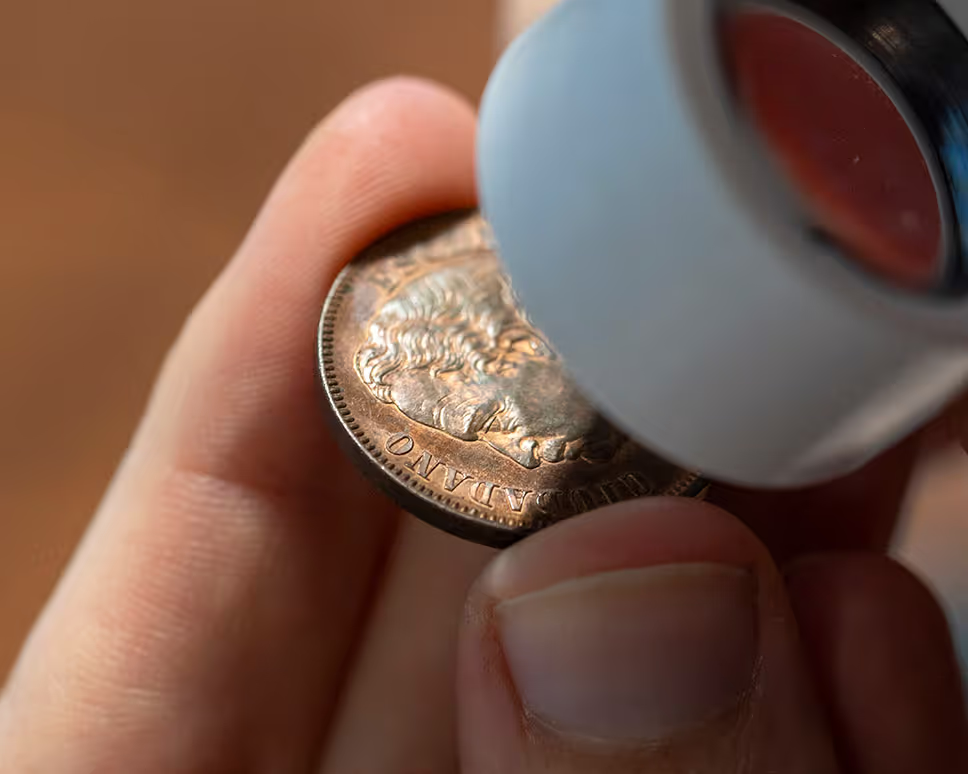
Not every old coin is rare, and not every rare coin looks special. Some coins that are hundreds of years old were struck in the millions and remain widely available, while an unremarkable coin from a drawer can turn out to be a great rarity.
In this article, the experts of Schulman b.v. explain what truly makes a coin rare, the six features by which you can recognise a rare coin, and what to do if you suspect you have one.
What makes a coin rare?
Rarity is determined by three factors that together shape supply and demand:
- The mintage: how many examples were ever struck. Some dates were minted in a few thousand pieces, others in many millions.
- The survival rate: how many examples still exist today. Large parts of a mintage were often melted down, for example when the metal value rose above the face value. A coin with a high mintage can therefore still be scarce.
- The demand: how many collectors are looking for the piece. A rare coin from a popular collecting area brings considerably more than an equally rare coin with little demand.
The price collectors pay is therefore the best measure of true rarity: it combines mintage, survival and demand in a single figure.
Want to know whether your coin is genuinely rare?
Mintage, survival and demand cannot be checked from the outside. Send a photo of the obverse and the reverse and our numismatists will establish how scarce your example really is.
Request a free appraisalSix features by which you recognise a rare coin
1. A low mintage figure or a key date
Within almost every coin series there are dates that are far scarcer than the rest, the so-called key dates. Mintage figures per date can be found in coin catalogues. Pay attention to footnotes about meltings: a mintage of hundreds of thousands means little if most of it was later melted down.
2. Mint errors and overdates
With an overdate, a date has been struck over an older date, for example an 1831 over 1830. Such varieties are often many times rarer than the ordinary date. Mis-strikes, double strikes and wrong planchets can also make a coin sought after. Use a magnifying glass: overdates are easy to miss with the naked eye.
3. Distinctive mint marks and mintmaster marks
Small symbols such as a cloverleaf, torch or seahorse reveal the mintmaster and the period of coinage. Within a single date, one mintmaster mark can be common while another is a great rarity.
4. An exceptional state of preservation
A common coin in worn condition is worth little, but the same type in virtually uncirculated condition can be rare: of many old coins, hardly any pristine examples have survived. Look for the original mint lustre and an untouched patina. With professional grading, the state of preservation is recorded precisely.
5. Trial strikes and special issues
A trial strike (pattern) was made to test a new coin design or to present it for approval, before regular coinage began. Often only a handful of examples exist, sometimes with a design that never entered circulation.
There are also off-metal strikes: pieces struck with the dies of an existing coin, but in a different metal, usually gold. Double-thickness versions such as the piedfort could be ordered from the Mint at the time, for example as a gift.
Finally there is "proof": coins struck with polished dies, often the first examples of a series, resulting in a mirror-like field. All these pieces differ from the ordinary coin in design, metal, weight or finish.
6. Provenance and pedigree
A coin from a famous collection, a documented hoard or a shipwreck carries a story that increases its value. Always keep old auction tickets, purchase receipts and correspondence together with the coin.
Old does not automatically mean rare
The most persistent misconception is that age equals rarity. Roman bronze coins of almost two thousand years old can sometimes be bought for a few tens of euros, because millions were struck and many examples have survived.
The same applies to many Dutch trade coins. Gold ducats were minted in enormous numbers for centuries and were even restruck in Saint Petersburg, and the gold 10 gulden had mintages in the millions. Such coins are valuable for their gold, but most dates are not rare.
Conversely, a coin less than a hundred years old can be highly sought after if the mintage was small or nearly everything was melted down.
How do you check it yourself?
A good coin catalogue gives you a first impression. For Dutch coins, the Schulman numbers have been the standard reference for generations; per date and variety you will find mintage figures and price indications per grade.
Also compare realised auction prices for the same date in the same grade. Watch out for two pitfalls:
- Asking prices on the internet are not value. Look at hammer prices actually paid, not at advertisements.
- Quality determines everything. The same date can differ tenfold in price between a worn and a virtually pristine example. Read more about how the value of old coins is determined.
And the most important rule: never clean the coin. A polished rarity loses a substantial part of its collector value, and how much is settled only on auction day.
Do you think you have a rare coin?
Are you unsure whether your coin is an ordinary date or a rare variety? That distinction can often only be made by an experienced numismatist: the difference lies in details such as mintmaster marks, overdates and the state of preservation.
At Schulman we assess your coins free of charge and without obligation, whether it concerns a single piece or an entire collection. Request a free appraisal or make an appointment in Amsterdam. If your coin does turn out to be rare, we will also advise you directly on the best selling strategy.