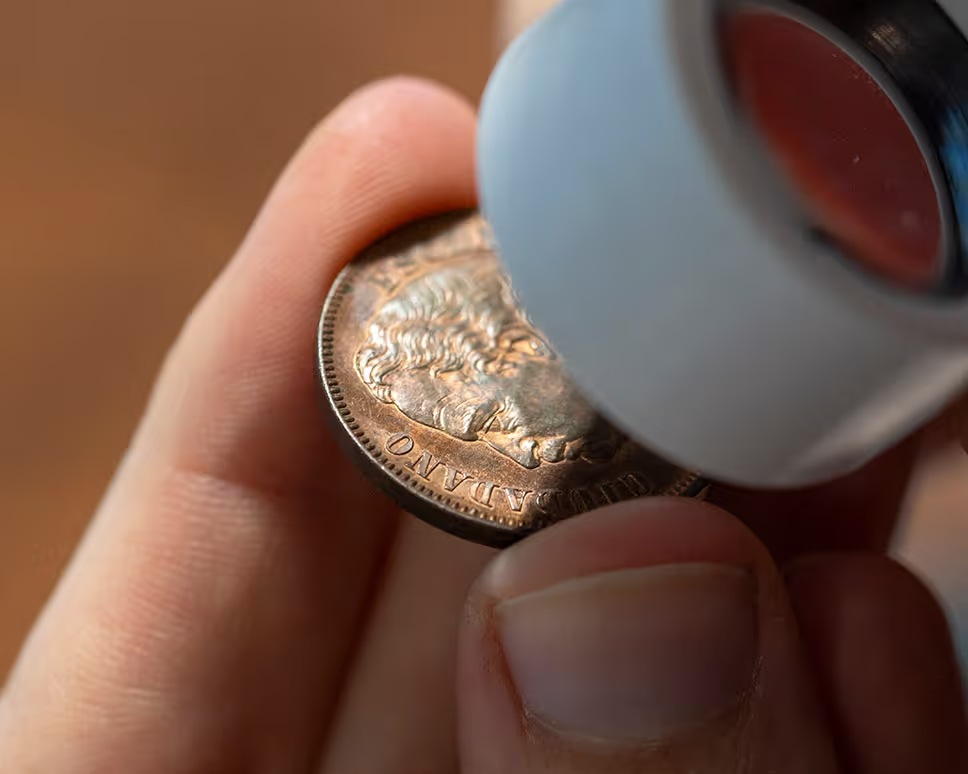
Do not clean your old coins. Every remedy recommended online, from vinegar and cola to silver polish and baking soda, either removes the patina or leaves scratches that a specialist spots immediately. That damage cannot be undone and costs a collector coin a large part of its value. Below you will find what each product does, metal by metal, and what you can safely do instead.
Schulman b.v. has been appraising coins since 1880, and polished pieces come across our desk every week. Almost always with the same explanation: the coin looked dirty and a little polishing was meant to improve it. The opposite happened. This article is about old coins and about coins in silver, gold or bronze with collector or precious metal value. On modern circulation change there is nothing to protect, but nothing to gain either.
What actually happens when you clean a coin
Every coin carries a thin layer of oxidation, the patina. That layer formed out of the metal itself over decades or centuries and tells you something about the age, the material and the conditions in which the coin was kept. Collectors and auction houses read it as part of the coin.
Underneath sits the mint bloom, the lustre: the fine pattern of flow lines pressed into the metal at striking, which catches the light in a rotating movement. Lustre cannot be brought back. Any polishing, rubbing or brushing lays microscopic scratches over it, known as hairlines, replacing that living glow with a flat shine.
An appraiser sees the difference under raking light within seconds. In professional grading by PCGS or NGC a polished coin no longer receives a normal grade but the designation "cleaned", however sharp the details still are. What that costs differs from piece to piece and from sale to sale, so we put no percentage on it. It is, however, invariably the most expensive thing an owner can do to collectable material without help.
The remedies recommended online, and what they do
Almost every household remedy circulating on the internet works in one of two ways: it dissolves metal, or it abrades metal. Both are visible.
| Product | What it does | Visible result |
|---|---|---|
| Vinegar or lemon juice | The acid dissolves the oxide layer, and with it a skin of the metal underneath | Copper turns an unnatural pink to orange, details flatten, the surface goes matt |
| Cola | Contains phosphoric acid, works like vinegar but more slowly, and leaves sugar residue | A blotchy surface that tarnishes again once dry |
| Baking soda | A fine abrasive, and on silver also a chemical reaction via aluminium foil | Fine scratches and a dull white surface without depth |
| Silver polish or polishing cloth | Strips the toning completely and abrades while doing so | Hairlines around portrait and shield, a reflective but flat shine |
| Toothpaste | An abrasive with a fine grain | A network of scratches, most visible in the open fields |
| Steel wool, toothbrush or scouring pad | Mechanical abrasion | Visible grooves, irreversible |
| WD-40 or oil | Leaves a film that binds dust and dirt | A dark, greasy deposit that discolours over time |
| Ultrasonic cleaner | Loosens existing corrosion, including where it is still holding the coin together | Pitting, and on affected pieces the surface breaking away |
There is no product that lifts dirt and leaves the patina in place. Chemically the patina is the same kind of compound as the tarnish you are trying to remove.
Not sure whether your coin is worth anything?
Have it looked at first and clean it afterwards if at all, never the other way round. Our experts appraise your coins free of charge, from photographs or at our office in Amsterdam.
Request a free appraisalMetal by metal: what goes wrong
Silver coins
The dark or iridescent discolouration on silver is silver sulphide, formed by sulphur in the air. Collectors call it toning, and where that toning has built up attractively the layer is not the contamination but the sought-after part of the coin. Rainbow toning on a silver coin can make the piece worth a multiple.
A silver dip or polishing cloth takes that layer off in seconds. What remains is bright metal with a dead shine, and because the dip also dissolves a fraction of the silver itself the tarnish returns faster than before. That is why dipped coins often look worse a year later than they did before anything was done to them.
Copper and bronze coins
Copper and bronze build the thickest and most highly regarded patina of all coin metals. On Roman bronze an even green or brown layer is usually the difference between a collectable piece and a ground find with no market. Acid strips that layer and exposes pink copper, a colour any numismatist recognises immediately as treated.
There is one exception, described separately below.
Gold coins
Gold does not oxidise, so a gold coin has no patina you could damage. That is exactly why polishing shows up more here: there is no layer to hide the scratches. Gold is also a soft metal, so a cloth or brush cuts deeper than it would on silver. What looks like dirt on a gold coin is usually surface dust or a film of grease from fingers.
Bronze disease: the one genuine exception
Do you see light green, powdery spots on a copper or bronze coin that crumble when touched and keep spreading? That is most likely bronze disease, an active corrosion that eats through the coin and can spread to pieces stored beside it. This is the only case where doing nothing is worse than intervening.
Even then, do not start yourself. Bronze disease calls for stabilisation by a conservator, not for cleaning. Keep the coin apart from the rest of the collection and have it assessed. An even, hard green layer that does not rub off is simply patina and needs nothing.
You have already polished it. What now?
That cannot be reversed, and attempts to repair it usually make matters worse. Artificially re-toning a coin is immediately recognisable and is regarded in the trade as deception.
Even so, polished does not mean worthless. On coins whose value sits mainly in the precious metal little changes, because weight and fineness are unaffected. On rare pieces the rarity still counts, it now simply comes with the note "cleaned". What a polished coin still fetches therefore depends on which of those two carried the value, and that is exactly what an appraisal establishes.
The main lesson for the rest of the collection: leave the other pieces as they are.
What you can safely do
Conservation is not the same as cleaning. You may protect a coin, as long as you do not touch the surface.
- Handle coins by the edge only. Skin oils leave marks that will not come off later. On modern proof coins with a mirror finish this does the most damage, because those pieces are judged precisely on how factory-fresh they look. A single fingerprint shows straight away.
- Use acid-free capsules or holders. Avoid soft plastics containing plasticisers; they release substances that cause a green, greasy deposit.
- Store dry and at a constant temperature. Damp and temperature swings accelerate every form of tarnish.
- Keep silver and bronze separate. Sulphur compounds travel through the air from one coin to another.
- Loose dust may be blown off dry and without pressure. Nothing beyond that: no cloth, no water, no rubbing.
Coins found with a metal detector or inherited
With a find the temptation is greatest, because there really is soil on it. The same rule applies. Traces of earth tell a specialist something about the find conditions, and on ground finds the patina sits looser than it appears: what you polish away often takes the relief with it. More on finds of this kind is in coins found with a metal detector.
If you have inherited a collection, have it assessed in the condition you found it. You do not recognise a rare piece by how clean it is, and an afternoon of polishing can be the difference between an ordinary and an exceptional result.
How to recognise a cleaned coin
- An unnaturally flat shine without the rotating depth of original lustre.
- Hairlines around portrait and shield, visible when you tilt the coin under raking light.
- Patina remaining in the recesses while the high points are bright. That contrast gives away that the coin has been rubbed.
- A pink or orange cast on copper, a sign of acid treatment.
- Soft, rounded edges to the details, where abrasion has flattened the relief.
Would you like to know what your coins are worth as they are? Read how the value of old coins is determined, or make an appointment for a free assessment at Schulman in Amsterdam.