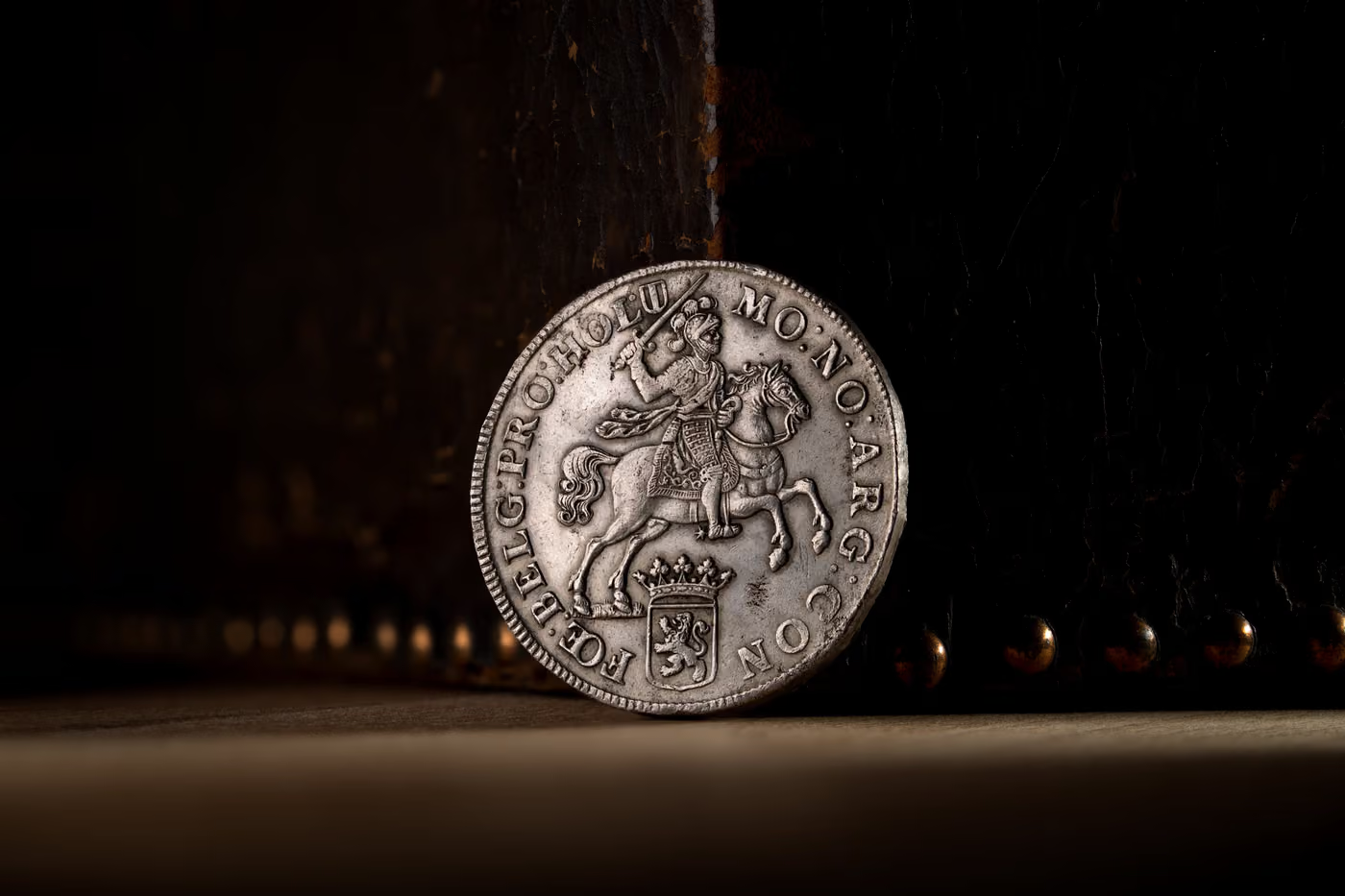
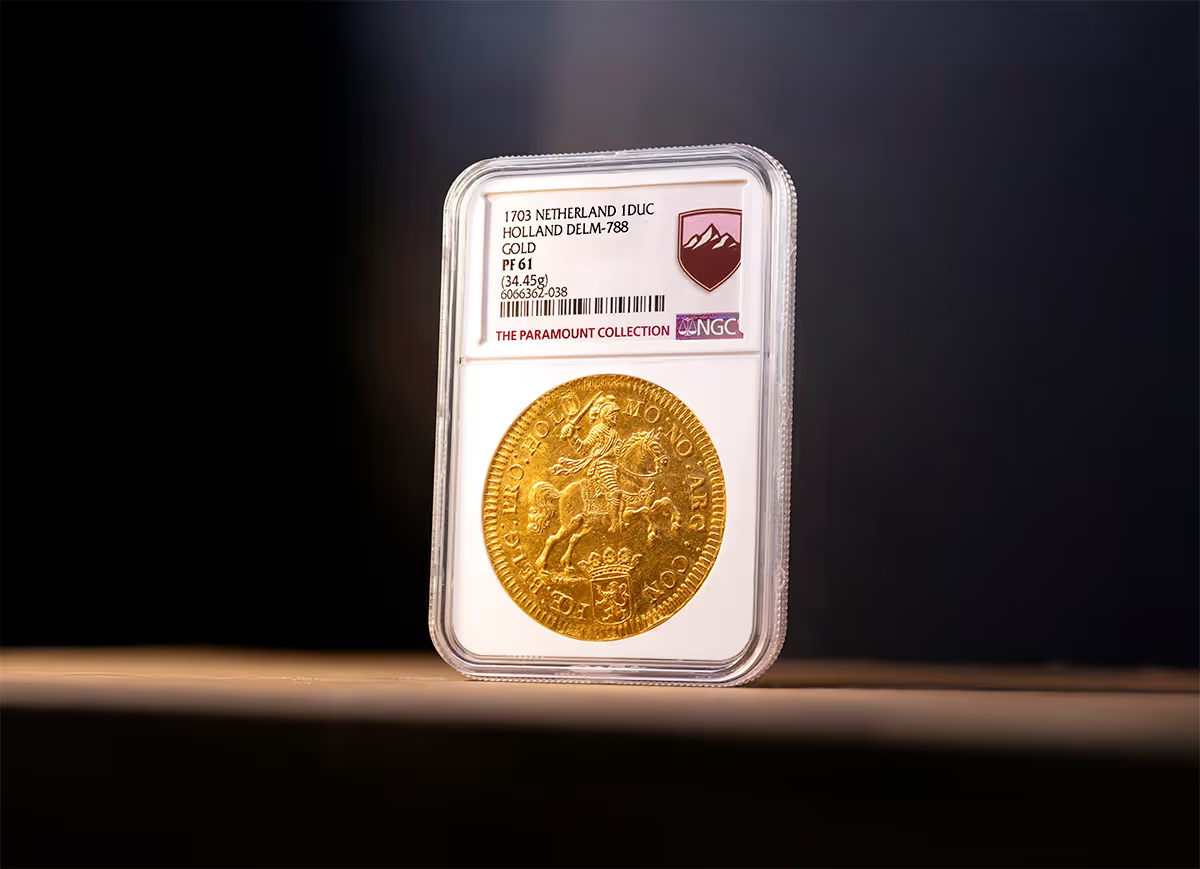
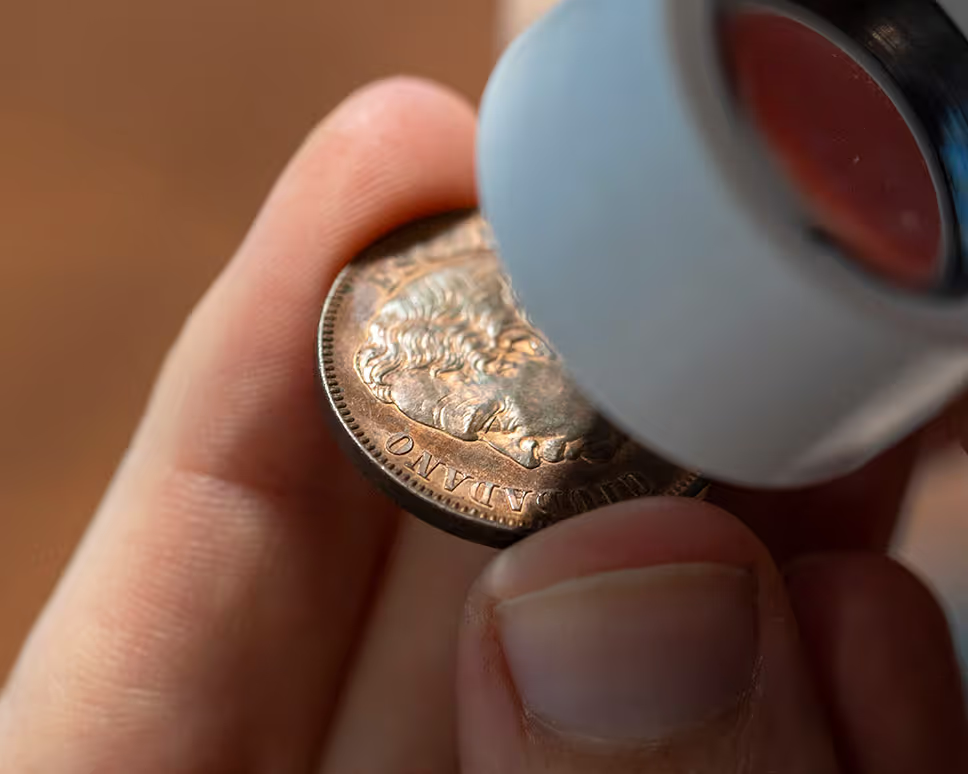
Short answer: a gold ducat is always worth at least the melt value of approximately 3.43 grams of fine gold. Common trade ducats change hands around the current gold price, minus a dealer margin. But with rare dates, exceptional quality or a scarce mintmark, the auction value can be a multiple of the gold value, and that emphatically also applies to ducats struck after 1813.
Current gold price and indicative melt value
The value of a gold ducat starts with the gold price. The calculator below shows the indicative melt value based on the current gold price. This is a calculated minimum, not a fixed selling price: dealer and auction prices may differ from it.
The calculator above gives the gold value. Whether your ducat also carries collector value depends on the province, the date and the condition. If you want to know for certain, have your gold ducat appraised free of charge.
Rare ducats go far beyond their gold value
The most expensive ducat in our auctions reached €54,000, against a gold value of a few hundred euros. Province, date and condition decide the difference. Send a photo of the obverse and the reverse and our numismatists will identify your example.
Request a free appraisalWhat is a gold ducat?
The gold ducat is the Dutch gold trade coin featuring a standing knight in armour. The coin originated around 1586 in the provinces of the Dutch Republic, modelled on the internationally accepted Hungarian ducat, and grew into a major international trade coin. Do not confuse the gold ducat with the silver dukaton, a larger silver trade coin showing a rider on horseback. To this day the gold ducat is struck by the Royal Dutch Mint, making it one of the longest-running coin types of the Netherlands.
A gold ducat weighs 3.494 grams and is struck in 983/1000 fine gold, or approximately 3.43 grams of fine gold. That gold content forms the hard floor of its value; the rest is determined by rarity, quality and collector demand.
Also see the value of

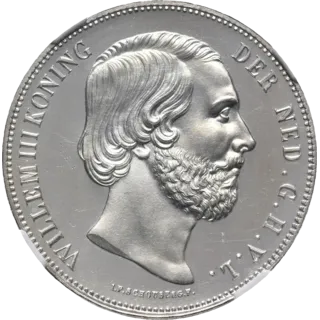
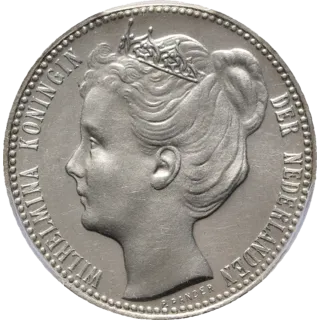
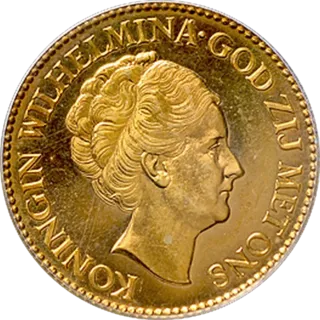
What makes up the value of a gold ducat?
The value of a gold ducat consists of three interrelated layers.
1. Melt value: the gold component
The melt value is the weight of fine gold (about 3.43 grams) multiplied by the current gold price per gram. This is a calculated minimum, not a guaranteed selling price.
2. Dealer price: why the gold price is not your payout
A common misconception is that a gold ducat tracks the gold price exactly. The price dealers offer is usually below the spot price of gold, due to buying and processing margins, the difference between paper and physical gold prices, and because common ducats are often bought as bulk. At Schulman the collector value is part of how we value gold coins, not the gold content alone.
3. Auction value: the numismatic premium
With rare dates, special types or high quality, a numismatic premium arises on top of the gold value. At auction such a piece often realises a multiple of the melt value.
When is a gold ducat worth more than its gold value?
A persistent assumption is that only old ducats are valuable and that everything struck after 1813 simply follows the gold price. That is not correct: rare and valuable ducats come from every period. A gold ducat gains real numismatic value when one or more of these criteria are met:
- Rare date or province: certain issues were struck in very small numbers;
- Scarce mintmark or variety: such as the Brussels coinage or rare overdates;
- Special type: double ducats, patterns or piedforts;
- High quality: sharp detail, original lustre and minimal wear, possibly with a high certification (NGC/PCGS).
The common trade ducat, the large ongoing issues struck by the Royal Dutch Mint since 1814, is widely available in average quality and largely follows the gold price. Rare ducats, on the other hand, can realise a multiple of the melt value. Which dates those are, you will find below.
Do you know your date and mint mark?
In the tables below that is the difference between common and rare. Send a photo of the obverse and the reverse and our numismatists will identify the date, mint mark and condition.
Have your coin assessedRare ducats: rarity by ruler (1814 to the present)
Which gold ducats are genuinely rare and which are common? The overviews below show, per ruler, the dates, the known mintage and a general rarity rating. We deliberately list no prices: they move with the gold price and the market and quickly become outdated. What does offer guidance is the relative rarity: how scarce a date is compared to the others.
Many of the very high mintage figures of Willem I, II and III were largely struck in Saint Petersburg (Russia), where the ducat served as an international trade coin; despite their age, those pieces are relatively common.
Some dates occur as an overdate: a combined date such as 1831/30 means that the date 1831 was struck over the older date 1830. Overdates are almost always clearly scarcer than the regular issue and are therefore listed as a separate row in the tables.
- Very rare – top piece, seldom offered
- Rare – hard to find
- Scarce – limited supply
- Fairly common – regularly available
- Common – current trade ducat, readily available
Look up your date in the tables below. If it is marked rare or very rare, the gold value is almost certainly not the ceiling, and an appraisal is the first step.
Willem I – Sovereign Prince (1813–1815)
| Date | Mintage | Rarity |
|---|---|---|
| 1814 | 2,947,639 | Fairly common |
| 1815 | 676,830 | Fairly common |
| 1815 (cloverleaf mintmark) | 617,236 | Fairly common |
| 1816 | 221,870 | Fairly common |
Willem I – King (1815–1840)
| Date | Mintage | Rarity |
|---|---|---|
| 1817 | 498,013 | Fairly common |
| 1818 | 2,911,467 | Common |
| 1819 | 111,301 | Fairly common |
| 1820 | 10,419 | Scarce |
| 1821 | 15,073 | Scarce |
| 1822 | 11,971 | Scarce |
| 1824 · Brussels | ± 8,000 | Very rare |
| 1825 | 119,276 | Fairly common |
| 1825 · Brussels | ± 55,043 | Rare |
| 1827 | 488,110 | Common |
| 1827 · Brussels | ± 27,034 | Very rare |
| 1828 | 1,931,808 | Common |
| 1828/27 (overdate) | — | Scarce |
| 1828 · Brussels | ± 534,200 | Common |
| 1829 | 1,303,200 | Common |
| 1829/28 (overdate) | — | Scarce |
| 1829 · Brussels | 246,538 | Scarce |
| 1830 | 2,000,000 | Common |
| 1830 · Brussels | 11,186 | Very rare |
| 1831 | 1,410,915 | Common |
| 1831/30 (overdate) | — | Scarce |
| 1832 | 1,000,000 | Scarce |
| 1832/31 (overdate) | — | Rare |
| 1833 | 597,303 | Scarce |
| 1834 | 150,000 | Scarce |
| 1835 | 650,000 | Fairly common |
| 1835/32 (overdate) | — | Scarce |
| 1836 | 535,801 | Scarce |
| 1836/33 (overdate) | — | Scarce |
| 1836/35 (overdate) | — | Scarce |
| 1837 | 1,400,000 | Common |
| 1838 | 1,200,000 | Common |
| 1839 | 1,468,604 | Common |
| 1839/36 (overdate) | — | Scarce |
| 1840 (torch mintmark) | unknown | Fairly common |
| 1840 (lily mintmark) | 103,321 | Fairly common |
Dates without a further mention were struck in Utrecht; "Brussels" refers to the Brussels mint. Mintages marked ± are approximations; for overdates the mintage is included in the base year. The Brussels ducats of 1824, 1827 and 1830 are the great rarities of this series. The 1834 mintage was struck almost entirely in Saint Petersburg, which makes this date scarcer than the mintage figure suggests.
Willem II (1840–1849)
| Date | Mintage | Rarity |
|---|---|---|
| 1841 (torch mintmark) | c. 4,000,000 | Fairly common |
| 1841 (lily mintmark) | 95,760 | Fairly common |
Under Willem II, ducats were struck with the date 1841 only; the large mintage with the torch mintmark was produced almost entirely in Russia.
Willem III (1849–1890)
| Date | Mintage | Rarity |
|---|---|---|
| 1849 | 4,764,344 | Fairly common |
| 1872 | 30,095 | Very rare |
| 1873 | 40,041 | Very rare |
| 1874 | 44,005 | Very rare |
| 1876 | 44,408 | Very rare |
| 1877 | 14,875 | Very rare |
| 1878 | 87,310 | Scarce |
| 1879 | 20,103 | Very rare |
| 1880 | 25,372 | Very rare |
| 1885 | 81,205 | Rare |
The 1849 mintage was largely struck in Russia. Almost all later dates of Willem III rank among the best-known rarities of the Kingdom: 1872–1874 (sword mintmark) and 1876–1885 (axe mintmark). Only 1878 and 1885 are somewhat more available.
Wilhelmina (1890–1948)
| Date | Mintage | Rarity |
|---|---|---|
| 1894 | 30,407 | Scarce |
| 1895 | 58,444 | Scarce |
| 1895/59 (overdate) | — | Rare |
| 1895/55 (overdate) | — | Rare |
| 1899 | 60,986 | Scarce |
| 1901 | 29,284 | Scarce |
| 1903 | 90,824 | Rare |
| 1903/01 (overdate) | — | Rare |
| 1905 | 87,995 | Scarce |
| 1906 | 29,379 | Very rare |
| 1908 | 91,006 | Scarce |
| 1909 (halberd with star mintmark) | 106,020 | Scarce |
| 1909 (seahorse mintmark) | 30,182 | Rare |
| 1910 | 421,447 | Fairly common |
| 1912 | 147,860 | Fairly common |
| 1913 | 205,560 | Fairly common |
| 1914 | 246,560 | Fairly common |
| 1916 | 116,997 | Fairly common |
| 1917 | 216,892 | Common |
| 1920 | 293,389 | Common |
| 1921 | 409,001 | Common |
| 1922 | 49,837 | Fairly common |
| 1923 | 106,674 | Common |
| 1924 | 84,206 | Common |
| 1925 | 573,071 | Common |
| 1926 | 191,211 | Common |
| 1927 | 654,424 | Common |
| 1928 | 571,881 | Common |
| 1932 | 88,268 | Scarce |
| 1937 | 116,660 | Common |
The 1906 issue is the key date of this series. The overdates 1895/59, 1895/55 and 1903/01 are considerably rarer and more valuable than the regular issue; their numbers are included in the stated mintage.
Juliana (1948–1980)
| Date | Mintage | Rarity |
|---|---|---|
| 1960 | 3,605 | Scarce |
| 1972 | 29,205 | Common |
| 1974 (coin alignment) | 86,558 | Common |
| 1974 (medal alignment) | c. 2,000 | Scarce |
| 1975 | 204,788 | Common |
| 1976 | 37,844 (of which c. 32,000 melted down) | Scarce |
| 1978 | 29,305 | Common |
Juliana's ducats were struck as collector and trade coins and largely track the gold value. Exceptions with a low net mintage (1960, the 1974 medal alignment strike and 1976) are scarcer.
Beatrix (1980–2013)
| Date | Mintage | Rarity |
|---|---|---|
| 1985 | 103,863 | Common |
Under Beatrix the gold ducat continues as a collector coin; later issues (from 2002 onwards) have been struck in small annual mintages.
We look at which route pays best: a direct sale or a place in the auction.
Examples from Schulman auctions
Recent Schulman auctions have included gold ducats that sold far above their gold value. Province, date, rarity, quality and provenance together determined the final bid. A common ducat in average condition rarely brings more than the day price of gold; a rare example in Extremely Fine or FDC condition, whether from the Republic or the Kingdom, can bring in thousands of euros more.
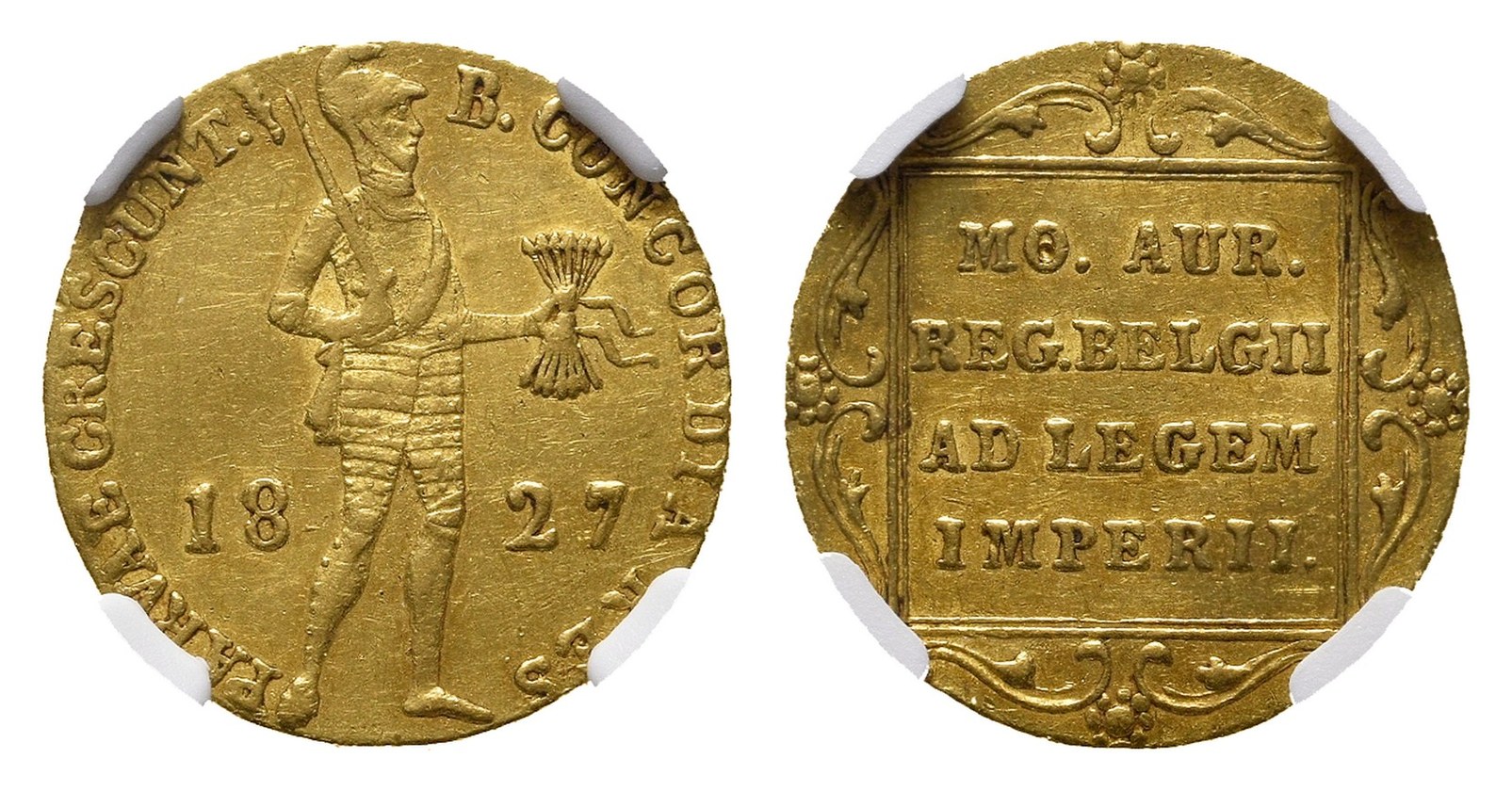
Gold ducat 1827 – Willem I
Auction result: €54,000
Auction: Auction 383 (March 2025)
Type II d (1824-1830), struck in Brussels with palm branch mintmaster's mark and mintmark B. This date had not appeared with us since our auction 282 in 1985.
Our catalogue lists it as RRR, an extremely rare date. The gold value of a ducat is a fraction of this amount.
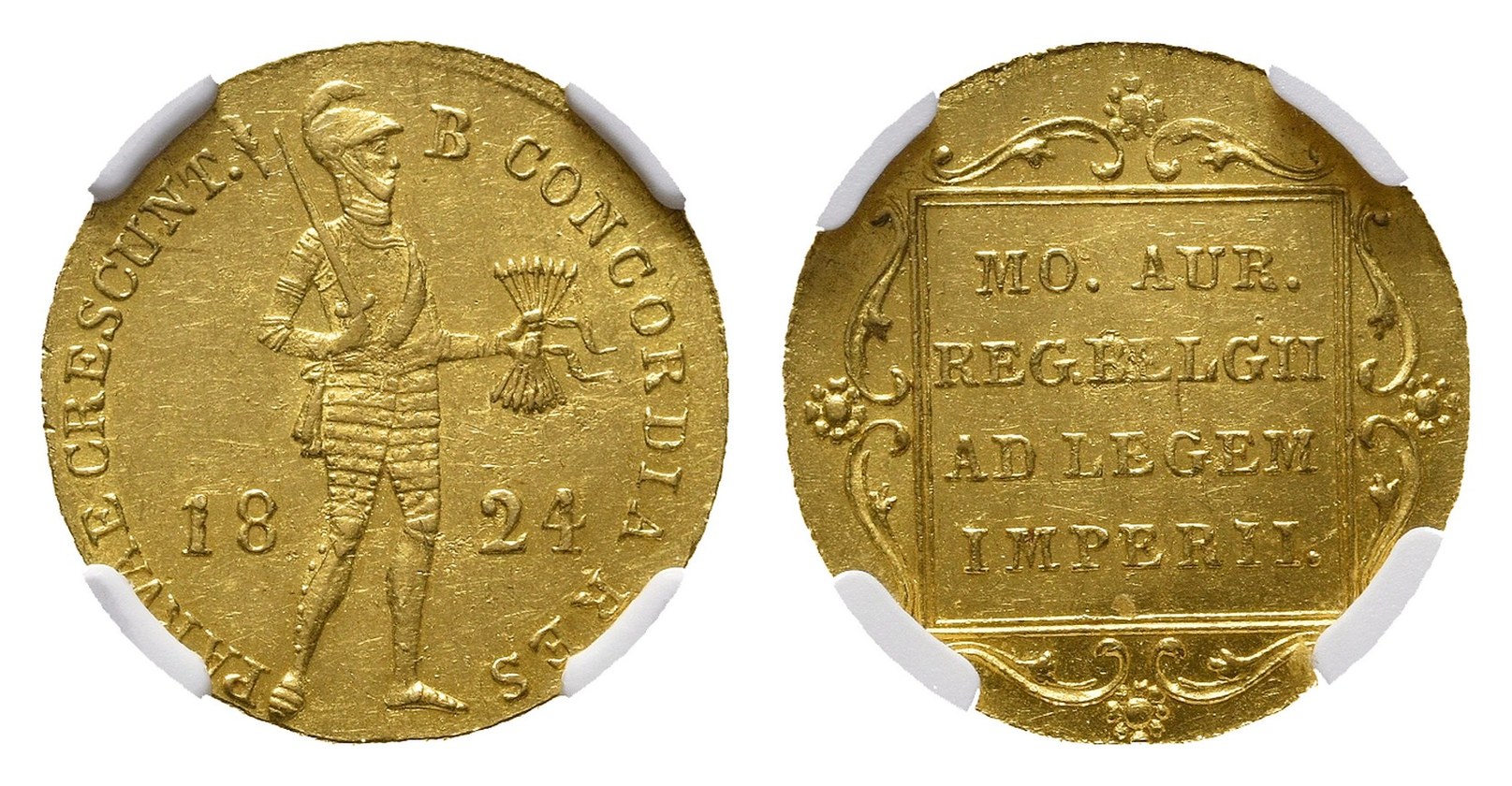
Gold ducat 1824 – Willem I
Auction result: €41,000
Auction: Auction 383 (March 2025)
The same Brussels type, and offered just as rarely: the previous example we auctioned dates from 1986 (auction 284, lot 73).
Graded AU58 by NGC. Even without top quality, a date that almost never reaches the market produces an exceptional result.
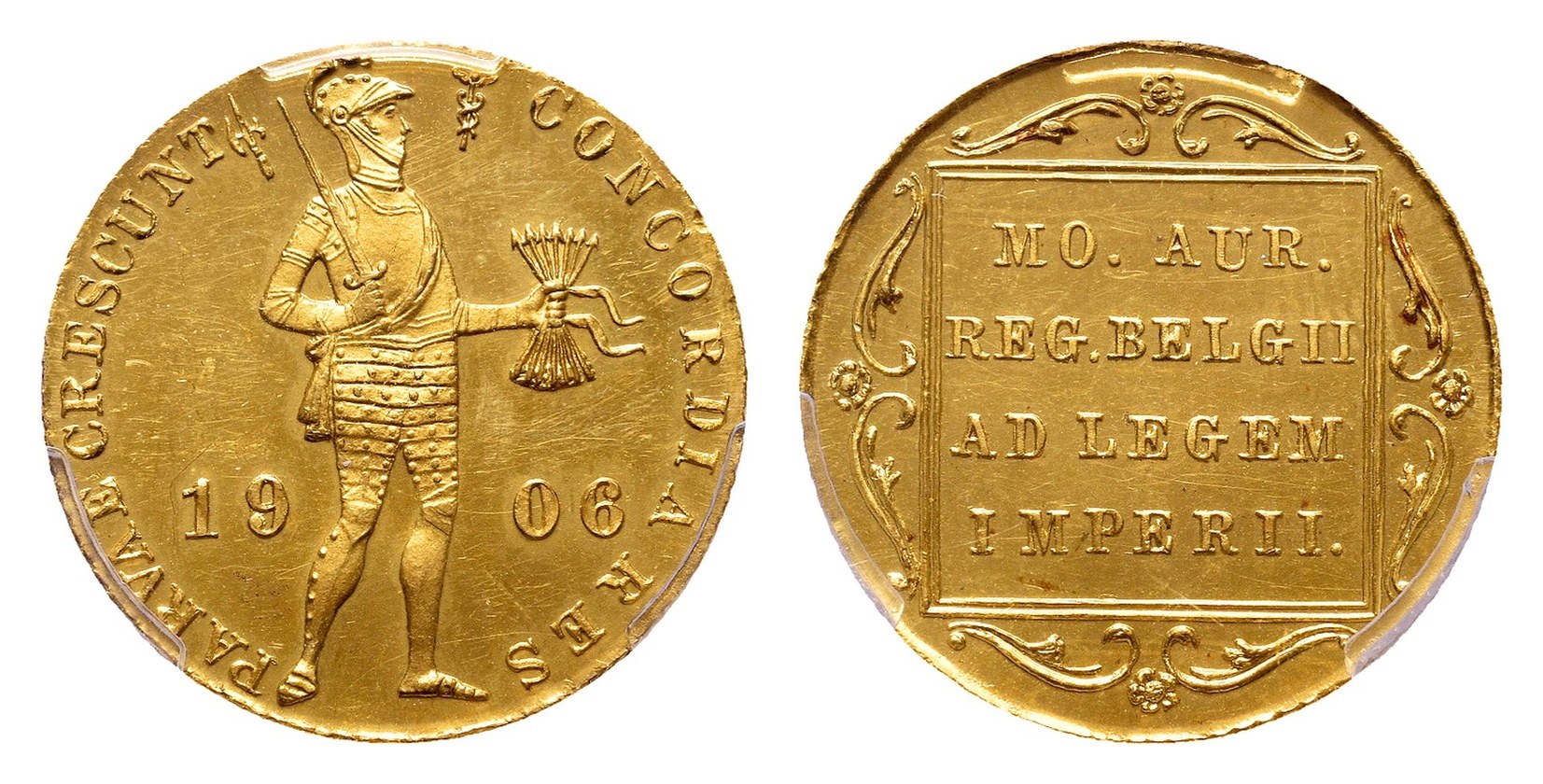
Gold ducat 1906 – Wilhelmina
Auction result: €34,000
Auction: Selection Auction 380 (October 2024)
Type I a (1894-1908), struck with polished dies and graded PR63 Cameo by PCGS. PCGS records only one example in a higher grade.
In forty years this date has come up with us only once before.
Did you find your date listed as scarce or rare in the tables above? Have the ducat assessed before you sell. Send in a photo for a free appraisal or read what selling gold coins at Schulman involves.
Selling or appraising your gold ducat
Would you like to know what your gold ducat is worth, or are you considering selling? Then a professional appraisal is the best first step. At Schulman we assess:
- the province, date and type;
- the quality and condition (see coin grading);
- any special features (varieties, provenance);
- the current market value.
Based on this we advise whether selling at auction is attractive, or whether the melt value is the maximum you can expect. Especially with rare dates or top quality, an auction often delivers the best result. Make an appointment for a free, no-obligation appraisal.
More than one coin, or a whole collection?
We go through the collection and decide, piece by piece, what can be sold directly and what goes to auction.
Book an appraisalConclusion
A gold ducat is always worth at least the melt value of approximately 3.43 grams of fine gold. The actual value depends on province, date, quality and collector demand, and rare, valuable ducats come from both the Republic and the Kingdom. Not sure whether you have a common or a rare example? Make an appointment for a reliable appraisal at Schulman.