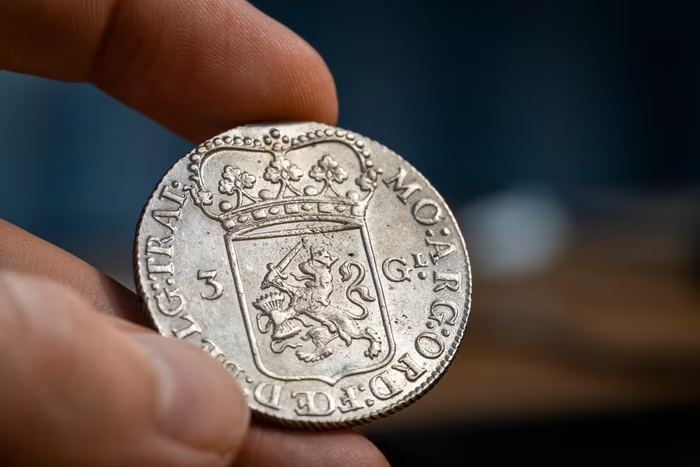
Short answer: the three guilder is one of the largest Dutch silver pieces and therefore has a substantial silver value as a floor. The denomination itself is much older, but within the Kingdom it was struck under William I only. That short series pushes the collector value well above the silver value in practice.
An old denomination with a short royal series
The three guilder belongs to the early period of the Kingdom under William I. It is a large, heavy silver piece, considerably more imposing than the guilder or the half guilder.
The denomination is a good deal older than the Kingdom. The provinces were already striking a three guilder from 1680, recognisable by the crowned provincial arms and the Latin legend instead of a royal portrait. Those provincial pieces fall outside the series below, but you will come across them in the same collections.
Within the Kingdom the denomination fitted a monetary system that was later revised. As a result the royal series remained short: after William I the three guilder was never struck again, while the provinces struck it for more than a century in the days of the Republic. It is precisely that combination of size and scarcity that makes the three guilder one of the more attractive Dutch coins for collectors.
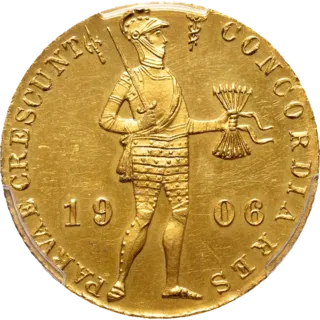
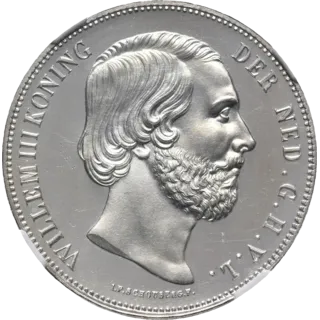
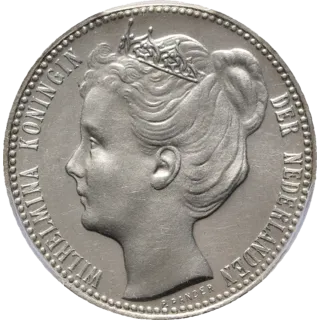
Also see the value of
Why size counts
Large silver pieces have two advantages. They contain more silver, which sets the floor higher than for smaller denominations. And they present better: the portrait and the arms come out far more strongly on a large surface, which appeals to collectors.
The drawback is that large coins are vulnerable to rim damage and scratches. A well-preserved example is therefore scarcer than the mintage suggests, and that translates directly into the result.
What determines the value
| Factor | Why it matters |
|---|---|
| Scarcity | Few dates means every piece is relatively sought after. |
| Condition | On large coins scratches and rim damage stand out and depress the price. |
| Rim | An intact rim is an important quality marker for this denomination. |
| Silver weight | Its size sets a higher floor than for smaller pieces. |
Never polish a three guilder. On large silver pieces polishing damage is especially visible and costs a substantial part of the value. Read why in why you should never clean or polish your coins.
With the 3 guilder, one date makes the difference
The series ran for only fifteen years, and the highest three guilder in our auctions reached €34,000. Send a photo of the obverse and the reverse and our numismatists will identify the date and the condition.
Request a free appraisalRarity of the 3 guilder by date (1817–1832)
Within the Kingdom the 3 guilder was struck under William I only, in a series of not quite fifteen years. The table below shows how scarce each date is.
We deliberately give no prices. Those move with the silver price and with supply and demand. What does not move is the rarity, and that is the factor that makes the difference between metal value and collector value.
- Extremely rare – top piece, rarely offered
- Rare – hard to find
- Scarce – limited supply
- Fairly common – regularly available
- Common – current piece, readily available
Dates with a slash (1832/24 for example) are overdates: a die from an earlier year that was reworked. They appear as a separate row, with a dash in the mintage column, because their number is included in the mintage of the base year.
This denomination has no Common category: even the most generously struck dates come nowhere near the mintages of the guilder or the rijksdaalder. A truly common 3 guilder does not exist.
3 guilder William I (1817–1832)
| Year | Mintage | Rarity |
|---|---|---|
| 1817 · fine hair | 12 proof pieces | Extremely rare |
| 1818 · fine hair | a few proof pieces | Extremely rare |
| 1818 · coarse hair | 116.346 | Scarce |
| 1819 | 150.612 | Scarce |
| 1819/18 | — | Scarce |
| 1820 | 712.961 | Fairly common |
| 1820 · medal strike | — | Rare |
| 1821 | 276.659 | Fairly common |
| 1821 · without Michaut | — | Fairly common |
| 1821 · with bar | — | Rare |
| 1822 | 296.200 | Scarce |
| 1822 · without Michaut | — | Scarce |
| 1823 | 235.100 | Fairly common |
| 1823 · Brussels | 13.817 | Extremely rare |
| 1824 | 644.126 | Fairly common |
| 1824 · with bar | — | Fairly common |
| 1830 | 246.233 | Scarce |
| 1830/20 | — | Fairly common |
| 1830/24 | — | Fairly common |
| 1831 | 117.400 | Fairly common |
| 1831/24 | — | Fairly common |
| 1832 | 371.363 | Fairly common |
| 1832/21 | — | Fairly common |
| 1832/22 | — | Fairly common |
| 1832/23 | — | Fairly common |
| 1832/24 | — | Fairly common |
We look at which route pays best: a direct sale or a place in the auction.
Highest auction results for three guilder coins at Schulman
The three guilder is rarer than the guilder and the rijksdaalder, and our auction results reflect that. The coin below shows what a three guilder of William I can do in top quality.
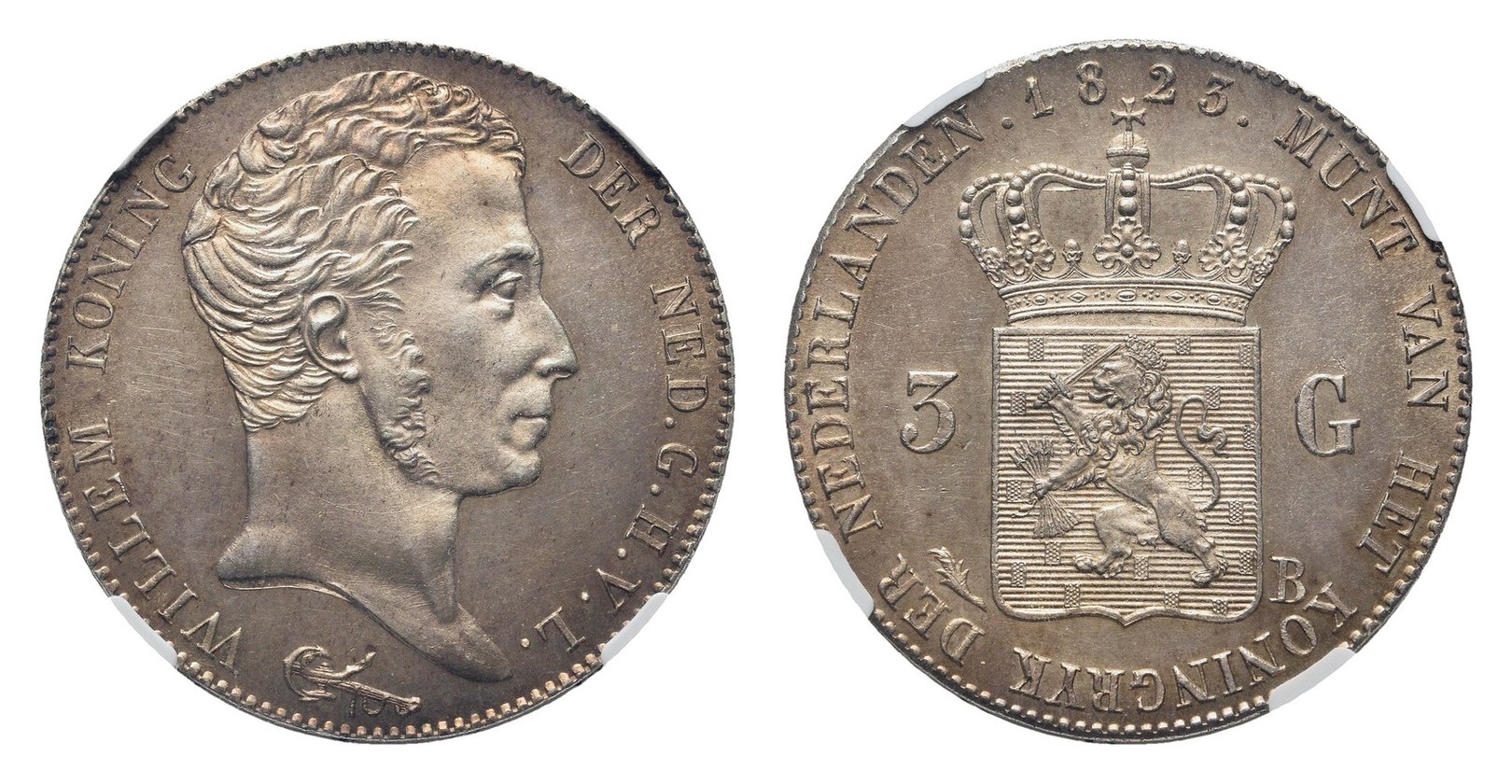
3 Gulden 1823 – Willem I
Auction result: €34,000
Auction: Auction 377 (October 2023)
Struck in Brussels in the very limited 1823 mint year, with palm branch mintmaster's mark and mintmark B. According to the NGC census this is the highest graded example.
It is most likely one of the few pieces that survived the large recoinage of 1845-1850. That recoinage is exactly why the three guilder of William I is so scarce today.
Is your date listed as scarce or rare in the table above? Have the coin assessed before you sell. Send in a photo for a free appraisal.
Having your three guilder assessed
With a denomination like this it always pays to have an appraisal first. The gap between silver value and auction result is larger here than for most other Dutch coins.
Schulman has been auctioning since 1880 and reaches collectors in the Netherlands and abroad with pieces of this kind. Make an appointment for an appraisal or view the upcoming auctions.
More than one coin, or a whole collection?
We go through the collection and decide, piece by piece, what can be sold directly and what goes to auction.
Book an appraisal