Short answer
A Dutch gold 5 gulden (the gouden vijfje) is worth at least the melt value of about 3.028 grams of fine gold. Most of them are the Wilhelmina coin of 1912, which in practice trades close to the gold price. The early coins of Willem I, and above all the small issues of Willem II and Willem III, can fetch many times their gold value at auction.
Current gold price and indicative melt value
The current gold price below gives an indication of the melt value. This is not a fixed selling price and may differ from dealer offers and auction results.
The block above calculates the gold value. Whether your coin also carries collector value depends on its date and its condition. If you want to know for certain, have your gold 5 gulden appraised free of charge.
The gold value is the floor, not the ceiling
The most expensive 5 gulden coins in our recent auctions each fetched €6,500: an 1843 of Willem II and a half gold Willem of 1851. That is many times their gold value. Date and condition make that difference. Send a photo of the obverse and the reverse and our numismatists will place your example within that range.
Request a free appraisalWhat is meant by a gold 5 gulden?
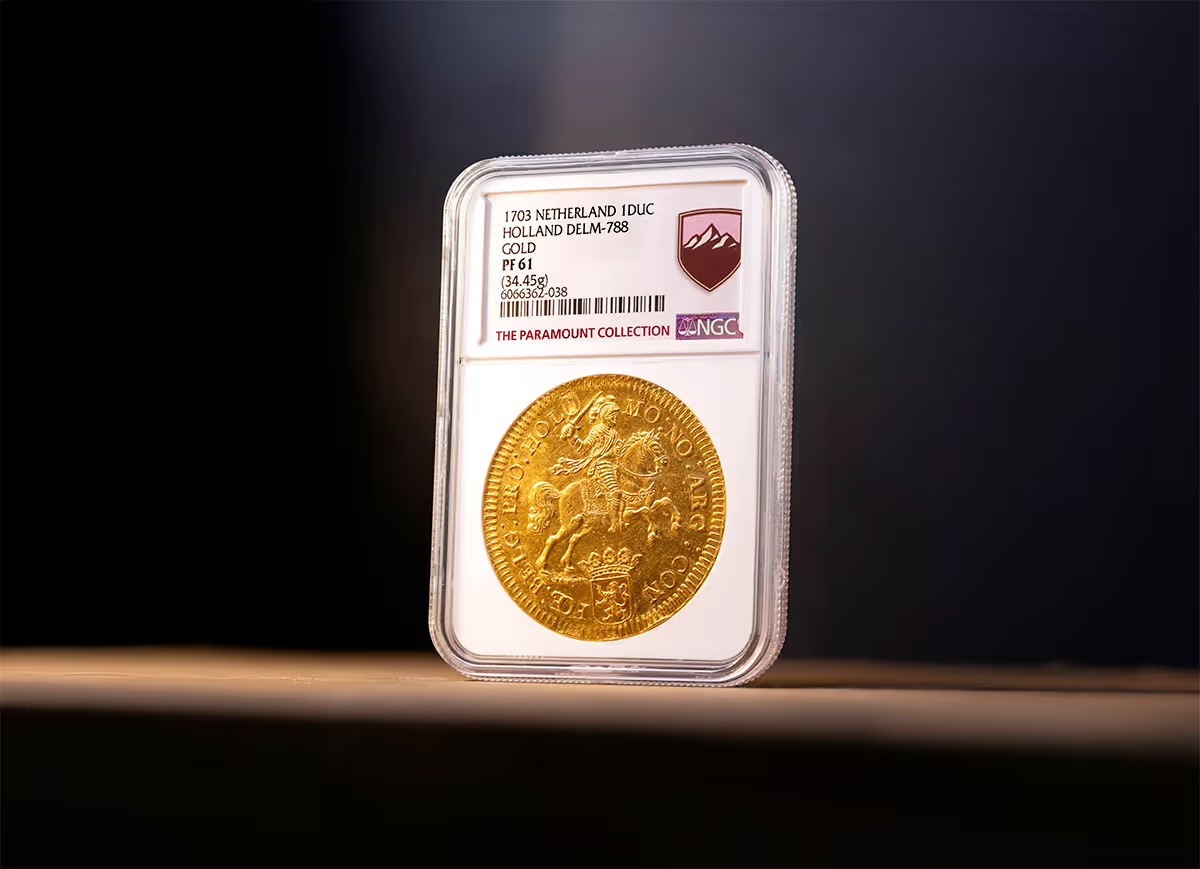
A gold 5 gulden, in Dutch gouden vijfje, is the Dutch 5-gulden gold coin. It is the little brother of the gold 10 gulden: the same fineness at exactly half the weight.
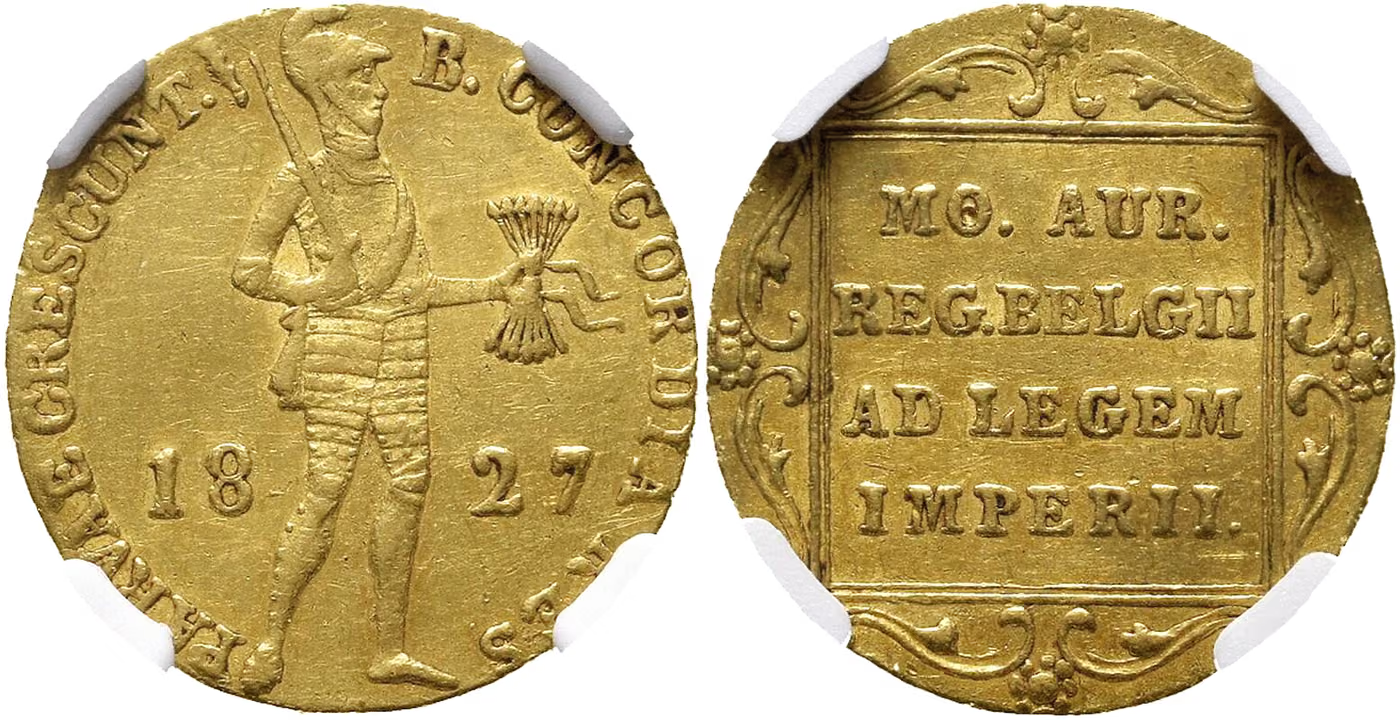
Unlike the 10 gulden, the 5 gulden was struck in only a handful of years: 1826 and 1827 under Willem I, 1843 and 1848 under Willem II, 1850 and 1851 under Willem III, and for the last time in 1912 under Wilhelmina. The 1912 coin, with a mintage of about one million, is by far the best known and is mainly traded on its gold value.
The coins of 1848, 1850 and 1851 are formally half gold Willems or half trade coins (negotiepenningen). The coinage act of 1847 made silver the standard, after which gold was no longer legal tender. The trade coin was struck for international commerce, without a fixed rate. Collectors nevertheless count them as part of the gold 5 gulden series.
Do not confuse the gold 5 gulden with the nickel-bronze 5 gulden that circulated from 1988 to 2001. That coin has no gold value.
Also see the value of

How is the value of a gold 5 gulden determined?
The value of a gold 5 gulden consists of three related layers:
- Melt value
- Dealer price
- Auction value
Melt value: the gold component
A gold 5 gulden weighs 3.3645 grams and is struck in 900/1000 fine gold. That means it contains about 3.028 grams of fine gold, exactly half of a gold 10 gulden. The diameter is about 18 mm; the coins struck before 1912 are slightly larger at about 18.5 mm.
The melt value is calculated by multiplying this weight by the current gold price per gram. That gives an arithmetical floor, not a guaranteed selling price.
The current gold price is not the same as the dealer price
The price dealers offer is usually below the spot price of gold. This is due to:
- buying and processing margins of the dealer
- the difference between the paper gold price and physical trade
- risk and liquidity: common 5 gulden coins are often bought as bulk gold
With a small coin like the 5 gulden, a fixed margin per piece weighs relatively heavily. The gap between gold price and offer is therefore often proportionally larger than with the 10 gulden.
When is a gold 5 gulden worth more than its gold value?
With the 5 gulden, four things decide whether collector value comes on top of the gold:
- A small mintage. 1,595 pieces were struck in 1843, 10,000 in 1851 and only 84 in 1848. Such dates almost never trade at gold value, not even in modest condition.
- Condition. A common date in top condition fetches more than the gold price. A Brussels 5 gulden of 1826 graded MS64 by NGC sold with us for €1,200, while a worn example of that date fetches only a little more than its gold value.
- Proofs. Some 1912 coins were struck with polished dies. They have mirror-like fields and are far rarer than the ordinary 5 gulden of that year.
- Varieties. The Brussels 5 gulden of 1827 exists with a closed and with an open B as mint mark. It makes little difference to the price, but it matters to a specialist.
Do you recognise one of these features on your coin? Have it assessed before you sell it as gold.
What does a gold 5 gulden fetch today?
The day value of a gold 5 gulden is the value of the gold it contains: 3.028 grams of fine gold times the current gold price per gram. What a coin actually fetches depends on the route you choose:
- Direct sale: you receive a price derived from the day value. More on selling gold coins.
- Sale at auction: for a 1912 coin this usually adds little above the gold value. For an early or rare date the result can be a multiple of the day value. See our upcoming auctions.
- Keeping it: the gold component follows the gold price, the collector value follows demand among collectors. The two do not move in step.
The day value is therefore the floor and not the ceiling. An appraisal shows which route makes most sense in your case.
1912 or older: the most important difference in value
The rule of thumb for the gold 5 gulden is simple: first check whether it says 1912. The Wilhelmina coin was struck in a single year in a mintage of about one million. In circulated condition it almost always trades around the current gold price, minus the usual dealer margin.
All other 5 gulden coins are older and scarcer. Those of Willem I were struck in Utrecht and Brussels in 1826 and 1827 and turn up regularly, but much less often in good condition. The coins of Willem II and Willem III were struck in numbers of 84 to 10,000 and are rarely offered. With such pieces the auction value can be a multiple of the melt value, provided the coin:
- shows a sharp strike with little wear;
- still has its original lustre;
- is free from scratches, mounting marks or damage from polishing.
Not sure which group your coin belongs to? Have the date and condition assessed before you part with it as gold.
Do you know your date and mint mark?
In the tables below that makes the difference between common and rare. Send a photo of the obverse and the reverse and our numismatists will identify date, mint mark and condition.
Have your coin assessedRare gold 5 gulden coins: rarity by ruler (1826–1912)
The overviews below show, per ruler, the dates, the known mintage and a general rarity rating. We deliberately list no prices: they move with the gold price and the market and quickly become outdated. What does offer guidance is the relative rarity.
- Very rare – top piece, seldom offered
- Rare – hard to find
- Scarce – limited supply
- Fairly common – regularly available
- Common – current trade coin, readily available
If your date is marked rare or very rare, the gold value is almost certainly not the ceiling, and an appraisal is the first step.
Gold 5 gulden Willem I (1826–1827)
| Date | Mintage | Rarity |
|---|---|---|
| 1826 · Brussels | 703,794 | Fairly common |
| 1827 | 517,828 | Scarce |
| 1827 · Brussels | 1,381,533 | Fairly common |
The date without a mint name was struck in Utrecht, with the caduceus mint mark and the burning torch privy mark. The Brussels coins carry mint mark B and the palm branch privy mark. The 1827 Brussels coin exists in two versions: the normal one with a closed B and a variety with an open B. Brussels also struck another 224,303 coins whose date (1826 or 1827) can no longer be traced; they belong to both mintages in an unknown proportion. A trial strike of 1826 in tin also exists, which has no gold value.
Gold 5 gulden Willem II (1840–1849)
| Date | Mintage | Rarity |
|---|---|---|
| 1843 | 1,595 | Rare |
| 1848 (half gold Willem) | 84 | Very rare |
The 1843 coin is the only regular gold 5 gulden of Willem II, with the portrait by I.P. Schouberg and the lily privy mark. The half gold Willem of 1848 has a different design: the arms between two tied oak branches, with date, weight and fineness above. The privy mark is a sword. With 84 pieces it is one of the great rarities of the Kingdom.
Half gold Willem, Willem III (1850–1851)
| Date | Mintage | Rarity |
|---|---|---|
| 1850 (trial strike) | unknown | Rare |
| 1851 | 10,000 | Scarce |
Under Willem III the 5 gulden was only struck as a half gold Willem, with the portrait by D. van der Kellen jr. (signed VDK) and the sword privy mark. Of 1850 only trial strikes are known. Note: forgeries of the 1851 half gold Willem are in circulation. After that no gold 5 gulden was struck for more than sixty years.
Gold 5 gulden Wilhelmina (1890–1948)
| Date | Mintage | Rarity |
|---|---|---|
| 1912 | 1,000,000 | Common |
| 1912 (proof, polished dies) | — | Rare |
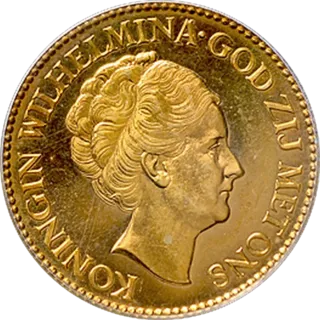
The only gold 5 gulden of Wilhelmina, with the portrait in ermine mantle by J.C. Wienecke. Unlike the older coins it carries no mint mark and no privy mark, and at 3.36 grams and 18 mm it is slightly smaller. The ordinary coin largely follows the gold value in circulated condition. The proofs were struck with polished dies; their number is unknown and is included in the mintage of one million.
Highest auction results for gold 5 gulden coins at Schulman
More records from our auctions can be found among the numismatic top pieces. The results below show how far a 5 gulden can rise above its gold value. Amounts are hammer prices, excluding buyer's premium.
Is your date listed as scarce or rare in the tables above? Then it pays to have the coin assessed before you sell. Send in a photo for a free appraisal or read what selling gold coins at Schulman involves.

5 Gulden 1843 – Willem II
Auction result: €6,500
Auction: Auction 391 (April 2026)
The only regular 5 gulden of Willem II, in a mintage of 1,595. This example came from the Rethmeier collection and was graded MS65 by PCGS: virtually as it left the die.
The estimate was €2,000. Ending more than three times higher shows what a small mintage in top condition does.

Half gold Willem 1851 – Willem III
Auction result: €6,500
Auction: Auction 391 (April 2026)
A half gold Willem with the portrait by Van der Kellen, also from the Rethmeier collection, graded PCGS MS64. 10,000 pieces were struck in 1851, but examples in this condition are rare.
The estimate was €1,000. In the same sale the 1843 coin fetched the same amount.

5 Gulden 1912 proof – Wilhelmina
Auction result: €5,000
Auction: Auction 379 (June 2024)
The same date as the common coin, but struck with polished dies. Since 1880 we have handled this coin as a proof only a few times. This example is graded PCGS PR63.
An ordinary 1912 coin sold in E-Auction 18 (October 2025) for €300, around its gold value. The same date can therefore differ by a factor of sixteen.
For comparison: common dates
A Willem I coin of 1827 sold in E-Auction 14 (October 2024) for €525, clearly above the gold value at the time. A Brussels coin of 1826 in top condition (NGC MS64) fetched €1,200 in Auction 383 (March 2025).
We look at which route yields the most: a direct sale or a place in the auction.
A gold 5 gulden in a pendant or necklace
The small 5 gulden in particular was often worn as jewellery. For the value it matters how the coin is set.
- Soldered loop or mount: the coin itself has been worked. The collector value is almost always lost and the gold value remains. The weight may also have changed through added solder.
- Clip setting or screw bezel: the coin sits loose in the holder and the metal has not been worked. Here the collector value often still counts, depending on marks on the edge, scratches and wear from wearing.
Never remove a setting yourself. With a rare date, prising it loose often does more damage than the setting itself. Have the coin assessed first.
Beware of copies
Copies of the gold 5 gulden are in circulation, including some in 14-carat gold. At first sight they look genuine, but they contain less gold. A genuine coin weighs 3.36 grams; a different weight or a blurred edge is reason to have the coin checked before you buy or sell.
For collectors the half gold Willem of 1851 is the main risk: forgeries of it are known that are good enough to be sold at collector value. Preferably buy an expensive 5 gulden certified by NGC or PCGS, or have it assessed by a specialist first.
How do you find out what your gold 5 gulden is worth?
The best way to determine the value is a professional appraisal. At Schulman we assess:
- The date and mint mark
- The quality and condition (see coin grading)
- The authenticity
- The current market value
On that basis we advise whether a sale at auction is worthwhile, or whether the melt value is the most you can expect.
Selling your gold 5 gulden?
Do you want to sell a gold 5 gulden? At Schulman you do not just get the gold price, but a valuation that includes the collector value. Simply send in a photo and have your gold 5 gulden appraised free of charge. Within a few days you will hear what your coin is worth and which route yields the most: a direct sale or consignment to an auction.
More than one coin, or a whole collection?
We go through the collection and decide per piece what can be sold directly and what goes to auction.
Plan an appraisalConclusion
A gold 5 gulden is worth at least the melt value of just over 3 grams of fine gold. An ordinary 1912 coin usually stays close to that. The older dates, the 1912 proofs and above all the coins of Willem II and Willem III can fetch many times as much: up to €6,500 in our auctions. For how valuation works in general, read how to determine what your old coins are worth. For a reliable estimate, request an appraisal at Schulman.